

Online Loans in Canada 2026: How Borrowing Really Works
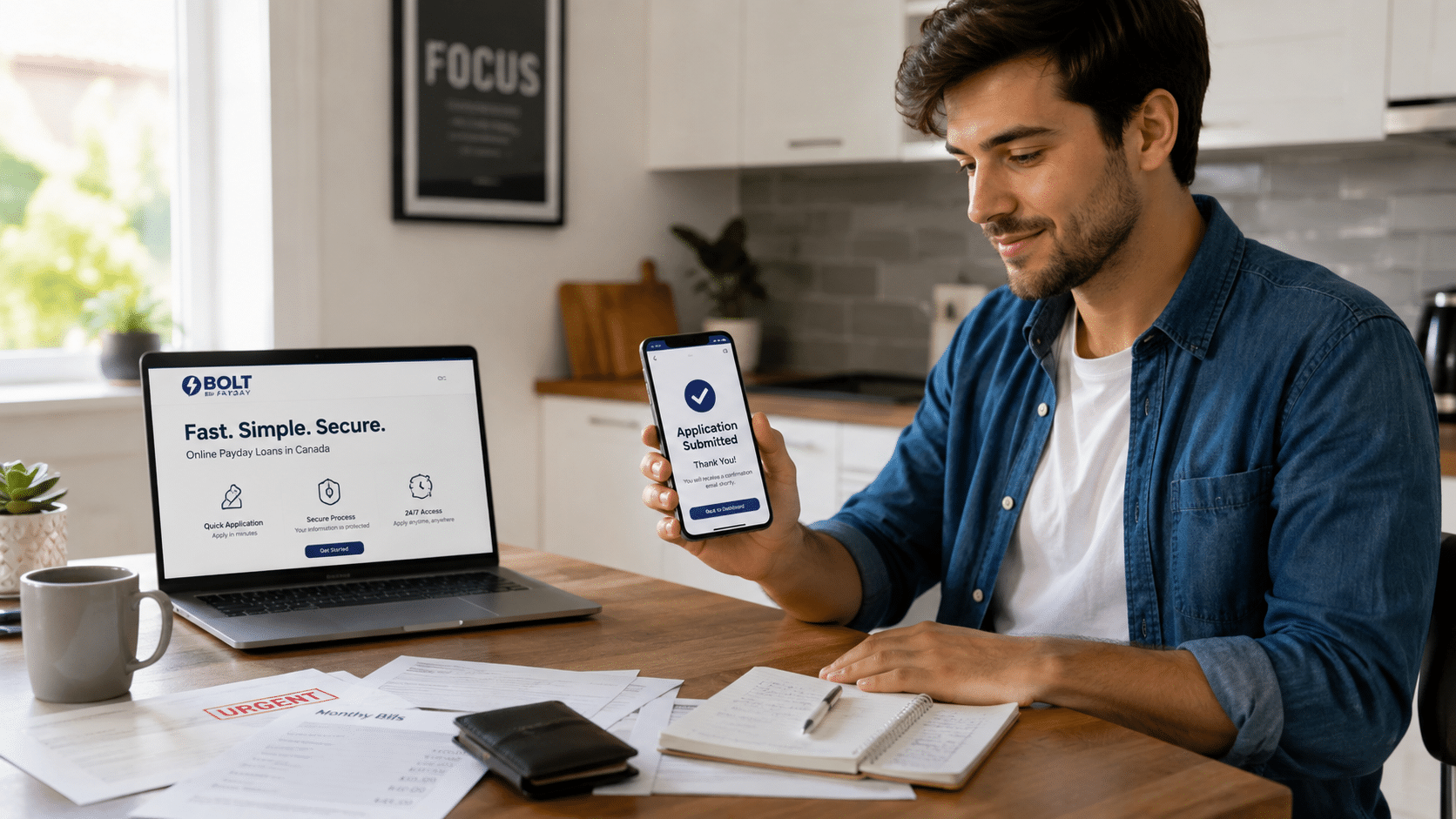
Borrowing money online in Canada looks simple. You fill out a form, wait a few minutes, and receive cash. The mechanics behind that form decide whether the loan helps you or hurts you.
Most borrowers do not get into trouble because online lending is a trap. They get into trouble because they pick the wrong product for the wrong situation. They also sign before they understand the real cost.
This guide explains how online loans work in 2026 from the ground up. It walks through the decision step by step. It also shows you where the real limits sit. Along the way, it points you to the right pages. There you can compare a payday loan against a personal loan using your own numbers.
One point matters from the start. Bolt Payday is not the lender. It runs a loan service that connects borrowers with participating lenders. The lender sets your rate, your schedule, and the cost of missing a payment. You can read about that setup on the About Us page.
What an Online Loan Means in Canada
An online loan covers any credit product you apply for, receive, and repay digitally. No branch visit, no fax, no in-person signature. The category covers four very different products. They share a delivery method but differ sharply in cost.
Canadians mostly meet payday loans, installment loans, personal loans, and bad credit loans online. These products are not interchangeable. A payday loan clears in full on your next pay date. A personal loan spreads fixed payments across one to five years. An installment loan sits between the two. Bad credit loans are not a separate product. Lenders simply price the same products for higher-risk borrowers.
This distinction is the most useful thing you can learn. The product sets the cost. The cost sets your monthly burden. That burden decides whether the loan solves your problem or adds to it.
How Lenders Evaluate Your Application
A clear sequence runs before any lender offers you money. Knowing it lets you prepare and improve your odds.
Step 1: Define Your Borrowing Need
Decide what the money is for before you touch a form. Most borrowers skip this step. It causes the most damage later.
A short-lived gap differs from a structural shortfall. A short-lived gap is a car repair three days before payday. The cash exists, but it has not landed yet. A short-term product fits a timing problem.
A structural shortfall is different. Think of a $4,000 dental bill, a debt consolidation, or slow-season business cash flow. The need does not clear on payday. It needs months of repayment. A short-term product does not fit that need.
Scope the need honestly and answer three questions. How much do you actually need, not how much can you borrow. How long until you can realistically repay. And what happens to your budget while you repay. The Bolt Payday forms ask for your loan purpose directly, from bills to debt consolidation to business growth.
Step 2: Pick the Right Type, Amount, and Term
Once you scope the need, the product almost picks itself.
A small need under roughly $1,500, due on your next pay cheque, suits a payday loan. It is fast, the approval is light, and you clear it in one payment. The payday loans Canada page shows how this works.
A larger need, from $500 into the low five figures, suits a personal or installment loan. The payments are smaller each period. The term runs longer. The annual cost sits far below a payday loan. The personal loans page covers amounts that scale up to $50,000.
Tie the loan amount to the need, not the approval ceiling. Lenders often approve more than you asked for because larger balances earn them more. Borrowing the maximum offered is one of the most expensive mistakes you can make. Borrow the need, repay it, and keep the door open for next time.
The term is your third lever. A longer term lowers each payment but raises total interest. A shorter term raises each payment but cuts total cost. Pick the shortest term whose payment fits your budget with room to spare.
Step 3: Check the Offer Before You Sign
A pre-approval is not a loan. It signals that a lender will likely proceed. It usually relies on a soft check that does not touch your credit score. The Bolt Payday form states this directly. The hard terms come from the lender. This is where you need to focus.
Verify five things in writing before you sign.
First, the APR. This is the true yearly cost, including interest and most fees. It is the only number that compares two loans fairly. A payday loan can carry an effective APR above 300 percent. A personal loan might sit between 20 and 46 percent.
Second, every fee. Watch for origination fees, admin fees, and the penalty for a missed payment. Regulated provinces cap the dishonoured payment fee on a payday loan, often at $20.
Third, the total cost of borrowing. Borrowers ignore this number most often. It is every dollar you repay minus the amount you receive. Borrow $1,000, repay $1,140, and your cost is $140. Ask for this figure in dollars, not a rate.
Fourth, the repayment schedule. Confirm the exact dates, the exact amounts, and the collection method. Most lenders collect by pre-authorized debit. Fund your account ahead of each date.
Fifth, the cost of non-payment. Ask what happens if a payment fails. Find out whether the lender reports to the credit bureaus. The Bolt Payday FAQ page covers late payment implications, and your agreement spells out the rest.
If any item is missing or unclear, do not sign. A reputable lender gives you time and full documentation. Most provinces also give payday borrowers a cooling-off period, often two business days, to cancel at no cost.
Why Borrowers Pick the Wrong Loan
The mechanics above show how the decision works. Now look at why borrowers choose badly and what follows.
Wrong Loan Type for the Job
The classic error uses a short-term payday loan for a long-term expense. Picture a $1,200 transmission repair, a cost that takes months to absorb. The borrower takes a payday loan because it is fast. The full balance falls due on the next pay cheque. They cannot cover $1,200 plus the fee from one pay period. So they fall short again, and the cycle starts.
Strong provincial rules ban rollovers, which helps. Even so, a borrower can take a fresh loan to cover the last one. The fee resets each time. A loan that costs $14 to $17 per $100 for two weeks is fair for a real two-week need. Stretched across three months, it becomes very expensive.
The reverse error also exists. A borrower with a $400 timing gap takes out a multi-year personal loan. The monthly payment looks small. Now they pay interest for years on a two-week problem. The fix was one short advance, repaid and closed. If you are unsure which fits, the payday or personal loan page helps you choose.
Loan Amount Bigger Than Your Income
The second failure borrows more than your income can service. Lenders judge this through a debt service ratio. Run the same check on yourself first.
Your new payment, added to current debts, should stay within reach even in a tight month. Most payday rules cap a single loan near 50 percent of net pay. A larger loan cannot realistically clear from one pay cheque. The same discipline applies to installment and personal loans. If the payment only works in a perfect month, it does not work.
The Bolt Payday forms collect your income, housing cost, and current debt payments first. That data tells the lender whether your requested amount is one you can carry.
The Three Trade-Offs You Cannot Avoid
Every borrowing choice balances three things that pull against each other. You rarely get all three at once.
The fastest products usually cost the most. A payday loan funds the same day with a light check. You pay for that speed through a high rate. A bank personal loan costs far less but moves slowly. Online personal loans sit in the middle, faster than a bank and cheaper than payday.
Ask whether the speed is worth the premium for your case. If a missed bill triggers a $60 reconnection fee and a fast loan costs $40, the math favours speed. If the need can wait two days, a cheaper product usually wins.
Flexibility forms the third trade-off. Payday loans are rigid, with one payment on one date. Installment and personal loans spread many smaller payments and often allow early repayment. Flexibility costs a little more interest, but it keeps larger loans survivable.
Payday, Installment, Personal, and Bad Credit Loans
These four labels cause more confusion than anything else in online lending. Here is how they actually differ in 2026.
Payday Loans
A payday loan is a small, short-term, high-cost loan. It usually runs $100 to $1,500 and clears on your next pay date within 14 to 62 days. Provinces regulate payday lending, not the federal government. Most regulated provinces cap the cost at $14 to $17 per $100 borrowed.
A $300 loan at $14 per $100 costs $42 over two weeks. You repay $342 in total. Annualized, that equals roughly 365 percent. The number looks alarming because annualizing a two-week product always inflates it. The real danger is repeated use, not the single two-week cost. You can review this product on the payday loan page.
Quebec stands apart. The province caps consumer credit near 35 percent APR. That makes traditional payday lending unworkable there.
Installment Loans
An installment loan repays through equal payments over a set term. The term often runs a few months to a couple of years. The rate sits below a payday loan and above a bank personal loan. It suits a borrower who needs more than payday offers. Bolt Payday serves this need through its broader personal loan options.
Personal Loans
A personal loan is the cheapest online option for most borrowers with fair credit. Amounts reach up to $50,000, and terms run one to five years. Payments stay fixed and predictable. The federal criminal interest rate dropped to an effective 35 percent in 2025. That change tightened the upper limit and protects borrowers. You can start on the personal loan form.
Bad Credit Loans
Bad credit loans are not a separate product. Lenders price payday, installment, or personal loans for higher-risk borrowers. Online, approval leans more on current income and banking than on credit score. That is why the no credit check payday loan option exists.
Be precise about what no credit check means. For many small loans, it means no hard inquiry that lowers your score. The lender still verifies income and banking. It does not mean no checks, and it never means guaranteed approval. Larger personal loans usually include a credit check. Treat any guaranteed approval claim with caution.
One Loan or Debt Consolidation
A borrower with several balances faces a different decision. Consolidation means one new loan that pays off the others. You then make a single payment at a lower blended rate.
Consolidation works when three conditions hold. The new rate beats the average of what you replace. The single payment fits your budget more comfortably. And you stop adding new debt to the cleared accounts. When these hold, you cut both cost and stress. When they fail, you simply stack a new loan on the old problem. A personal loan is the usual tool, because its lower rate makes the single payment work.
How Needs Scale: $500 to $35,000
Borrowing needs sit at different sizes. The right product shifts as the amount grows.
At the entry level near $500, the need is almost always a timing problem. A short-term or small installment loan fits. The dollar cost stays small when you repay on schedule.
In the mid range, from a few thousand up to $35,000, the need turns structural. This covers consolidation, major repairs, and large purchases. Here the product must be a personal or installment loan. The APR matters enormously because you pay it across years. Two points of rate on a $20,000 loan over four years is real money.
The lesson holds across the range. Small and short pairs with payday. Large and sustained pairs with personal. A mismatch in either direction costs you the most.
How Different Borrowers Decide
The same loan does not fit everyone. The reasoning shifts with experience and credit history.
A first-time borrower should choose understanding over speed. Read the full agreement. Confirm the total cost in dollars. Borrow the smallest amount that solves the problem. First-time borrowers often over-borrow because approval feels like permission. It is only an offer. You set the amount.
A repeat borrower carries a track record. On-time repayment can earn better terms over time. The risk is treating short-term borrowing as a budgeting tool. A payday loan used twice a year for emergencies is reasonable. The same loan used monthly signals a budget that needs attention.
A borrower with poor or thin credit should target income-based lenders. Report income honestly. Treat the first loan as a chance to rebuild. On-time payments on a reported loan slowly strengthen your file. Misreporting income almost always backfires. The resulting payment becomes one you cannot sustain. You can check your standing through Equifax Canada or TransUnion Canada, which give you free access to your own report.
Who Qualifies for an Online Loan
The baseline requirements stay consistent across lenders. You must reach at least 18, the age of majority in most provinces. You must live in Canada. need a regular, verifiable income, often a minimum near $1,000 a month. also need an active chequing account for deposit and repayment.
Beyond the baseline, lenders weigh income stability, current debt, housing cost, and credit history. The Bolt Payday forms collect all of these, including any past bankruptcy or consumer proposal. Meeting the baseline gets your application reviewed. The fuller picture decides the offer.
What Happens If You Miss a Payment
This is the part borrowers most need to grasp before they sign.
A failed payment usually triggers a dishonoured payment fee from the lender. Regulated provinces cap that fee at $20 for payday loans. Your bank adds its own NSF charge. From there, the path depends on the lender. They may retry the debit, contact you, and later send the account to collections.
Collections carries real consequences. It can lower your credit score and bring collection calls. In some cases it leads to legal action. Missed payments on reported loans make future borrowing harder and more expensive. You can avoid this chain. Borrow what you can repay and contact the lender early if your situation changes.
If repayment becomes truly unmanageable, speak with a licensed insolvency trustee or a non-profit credit counsellor. Do not take another loan to cover the last one. Adding credit to a repayment problem only deepens it. Your agreement and the FAQ page set out how your lender handles missed payments.
Online Lenders Versus Banks and Credit Unions
At the same borrowing tier, the trade-offs stay predictable. Banks and credit unions offer the lowest rates and strong protections. But they move slowly, demand stronger credit, and decline thin-file applicants more often. Online lenders move faster and accept imperfect credit, yet they charge more, especially at the short-term end.
A connecting service like Bolt Payday sits in a specific spot. It submits your application to a network of lenders rather than one institution. That can widen your options. The trade-off is that it does not control the final terms. You still read and accept the lender’s specific offer.
A borrower with strong credit and time should start at a bank. A borrower who needs cash fast, or has been declined elsewhere, often turns to an online service. Knowing which borrower you are tells you where to begin.
Frequently Asked Questions
How fast can I actually get an online loan in Canada?
Most online payday loans approve within minutes and fund the same business day. Some lenders deposit within one to two hours when everything verifies cleanly. Larger personal loans take longer because they need a fuller review, sometimes a day or two. Your speed depends on when you apply and your bank’s processing times. Weekend applications can delay the deposit even when approval is instant. Have your income and banking details ready before you start the application form.
Does applying for an online loan hurt my credit score?
Applying through a service like Bolt Payday usually triggers only a soft inquiry. A soft inquiry does not affect your credit score, and the form states this. It lets a lender pre-assess you without leaving a mark. A hard inquiry usually happens only when you accept a specific offer, mostly on larger loans. Payday products often rely on income and banking checks instead. What truly hurts your score is missing payments after funding, since lenders can report those.
What is the real cost of a payday loan in Canada in 2026?
Most regulated provinces cap the cost at $14 to $17 per $100 borrowed. A $300 loan at $14 per $100 costs $42 over two weeks, so you repay $342. Annualized, that runs near 365 percent, because annualizing a two-week product always inflates the number. The dollar cost on one short loan stays modest, but repeated borrowing compounds it fast. A missed payment adds a fee capped at $20, plus your bank’s NSF charge. Always confirm the total cost in dollars before you sign.
Can I get an online loan with bad credit or no credit history?
Yes, many online lenders approve borrowers with poor or thin credit. They weigh current income and banking stability more than credit score, especially on small loans. That is the basis of the no credit check payday loan option. Here, no credit check means no hard inquiry rather than no assessment. You still need verifiable income, an active account, and the ability to repay. No lender truly guarantees approval, whatever an advertisement claims. Repaying a reported loan on time also helps rebuild a damaged file over time.
Should I choose a payday loan or a personal loan?
The right choice depends on the size of the need and how long it lasts. A payday loan fits a small timing gap you can clear from your next pay cheque. A personal loan fits a larger need, repaid in fixed monthly amounts at a lower rate. Using a payday loan for a long-term expense is the most costly common mistake. Using a multi-year loan for a two-week gap is the opposite error. The payday or personal loan page helps you match the product to the need.
What happens if I miss a payment on an online loan?
A missed payment first triggers a dishonoured payment fee, capped at $20 for payday loans in regulated provinces. Your bank adds its own NSF charge on top. The lender may retry the debit and contact you to arrange payment. Continued non-payment can send the account to collections. If the loan reports to the bureaus, the missed payment lowers your score. Contact the lender before the payment fails, since many will work out an arrangement. The FAQ page and your agreement cover the specifics.
Is Bolt Payday the lender, and who do I contact about my loan?
Bolt Payday is not the lender. It runs a service that connects borrowers with participating lenders. It facilitates the application rather than issuing the money. So it does not set your rate, your schedule, or the cost of non-payment. Those terms come from the lender you match with. Only that lender can answer questions about your specific rate, charges, or payments. Use the Contact Us page for questions about the service. The Privacy Policy explains how the site handles your information.