

Welcome to Bolt Payday: A Premier Canada Payday Loan Company
Bolt Payday operates boltpayday.ca as a loan connection service. We are not a bank. We are not the direct lender, we match Canadian borrowers with participating lenders who fund the loans.
This guide explains how online payday borrowing actually works. It walks through every decision a careful borrower should make. It covers real costs, accurate APR, eligibility, and repayment. We wrote it for people who want facts before they sign.
Who Bolt Payday Is and What We Actually Do
We connect applicants with one or more participating lenders. Your registration details get shared with those lenders. You stay under no obligation to accept any offer. You can decline an offer at any point before signing.
Only the lender sets your final rate and fees. Only the lender approves the loan and confirms terms. We do not control the lender’s terms after you sign. We never see the full details of your final contract.
Our site advertises amounts up to roughly $2,000. Regulated payday loans in Canada usually run $100 to $1,500. Larger amounts often come as personal or installment loans. You can review our operator role and data-sharing terms before you apply.
Baseline Eligibility to Apply
You must be at least 18 years old, you must live in Canada as a resident, you must earn at least $1,000 per month. You must hold a valid Canadian bank account.
Meeting these makes you eligible to apply and be assessed. It does not guarantee any loan offer. Lenders still review your income and your banking activity. Eligibility is a starting line, not a finish line.
How an Online Loan Decision Gets Evaluated, Step by Step
A good loan decision follows a clear order. Rushing the steps is where borrowers get hurt. Work through each stage below before you apply.
Step 1: Define Your Borrowing Need and Use Case
Name the exact reason you need money. Most cases fall into a few clear buckets. Emergency cash covers a car repair or a medical bill. A bill before a pay cheque bridges a short gap.
Short-term cash flow smooths an uneven income week. Debt consolidation rolls several debts into one payment. A larger planned purchase needs a longer, structured loan. Each case points to a different loan type.
A two-week payday loan fits a true short gap. It does not fit a months-long expense. Matching the need to the product saves real money. So define the use case before you shop for cash.
Step 2: Choose the Loan Type, Amount, and Term
Select the type of loan that suits your needs. Use the least number to work out the problem. It is uncommon to borrow the most that is available. Keep the term of repayment in sync with your actual payment.
A payday loan is one that requires you to pay off when you get your next paycheck. Loans are paid in monthly installments and are either personal loans or installment loans. Extended terms reduce each payment, increase the interest. Brief periods are more affordable, but can be a tight budget. Choose the amount that you can afford, rather than the maximum that is approved.
Step 3: Read the Pre-Approval Offer Before You Sign
Read every number in the offer before you accept. Check the APR stated as a yearly percentage, check the fees written in plain dollars, check the total cost of borrowing in dollars, check the full repayment schedule and each due date.
Check the cooling-off period for cancelling without penalty. Ask the lender to explain anything that looks unclear. Our FAQ page covers eligibility, costs, and non-payment details. Only the lender can confirm your exact figures.
Step 4: Plan Repayment Before You Accept
Picture the repayment date before you take the money. Confirm you can cover the loan and your normal bills. Build a small buffer for the week repayment hits. Missing a payment adds fees and can start a cycle. A clear repayment plan keeps a short loan short.
What Payday Loans Really Cost in Canada (2026)
Payday loans are quick, however they cost much. Cost disclosure is a way to prevent a bad shock. So, in a nutshell, here are the actual numbers.
In most provinces, the averages for payday loan per $100 borrowed are $14.00. Take out a $300 loan for approximately 14 days. You pay $42 in fees. You repay $342 in total. That $14 per $100 looks small on a short loan. Stretched across a full year, it equals roughly 365 percent APR. We state the APR honestly and never hide it. The Financial Consumer Agency of Canada confirms these figures on canada.ca.
Loan Limits and Repayment Windows
Regulated payday loans usually cap at $1,500 or less. Borrowers get up to 62 days to repay. A missed or dishonoured payment carries an NSF fee. Most provinces cap that lender NSF fee at $20. Your bank may add its own separate NSF charge. These charges stack quickly when a payment bounces.
The 35 Percent Criminal Rate and the Payday Exemption
As of January 2025, Canada lowered the criminal interest rate. The new ceiling sits at 35 percent APR. Payday loans follow provincial rules under a specific exemption. That exemption lets them carry higher effective rates legally.
The high APR comes from the very short term. Spread the same dollar fee over months, and the rate falls. That is why many borrowers compare installment loans Canada structures instead. A longer, lower-rate loan can cost far less overall.
Rollovers, Cooling-Off Periods, and Disclosure
A rollover lets you pay a fee to extend a loan. Most provinces restrict or ban this practice. In Ontario, you cannot take a new payday loan first. You must repay the existing loan before borrowing again.
Many provinces require a cooling-off period of about two business days. You can cancel within that window without penalty. Lenders must disclose full cost in both dollars and APR. Clear disclosure is your right, so use it.
Quebec Is the Clear Exception
Quebec sets much stricter consumer credit limits. Those limits cap most consumer loans near 35 percent APR. That cap makes the conventional payday loans Quebec borrowers expect rare. Quebec residents usually find other short-term options instead. Rules in cities like Brampton, Hamilton, Calgary, and Winnipeg follow their own provincial caps. Anyone searching payday loans Brampton still pays under Ontario rules, not a city rule.
Payday Loans vs Personal Loans vs Other Short-Term Loans
There are different products to meet different requirements and budgets. If the wrong one is selected, the expense will be higher than it is needed to be. So compare them honestly before you decide.
Payday Loans and Cash Advances
A payday loan gives fast cash for a short gap. You repay it in full by your next pay cheque. Approval is quick and the credit bar is low. The trade-off is a high cost per dollar. This fits a genuine emergency, not a long expense. You can learn more about instant payday loans online in Canada on our cash advance page.
Personal Loans and Installment Loans
A personal loan spreads repayment across several months. Each payment is smaller and easier to budget. The total cost depends on the rate and the term. Many borrowers searching installment loans for bad credit Canada want this structure. People comparing a loan for bad credit also land here. We facilitate personal loans for borrowers across Canada through participating lenders.
Bolt Payday does not run a dedicated installment loan page. We still explain the option so you can compare fairly. An installment loan often beats a payday loan on total cost. It rarely matches a payday loan on raw speed.
Lines of Credit, Overdraft, and Credit Union Loans
Compare a payday loan against other tools at the same tier. A line of credit often charges far lower interest. Overdraft protection costs less than a payday loan per dollar. Some credit unions offer small fair loans near 19 percent APR. These take longer to arrange but cost much less. Weigh speed against cost before you commit.
One Short-Term Loan vs consolidating Several Debts
A single payday loan solves one small, urgent gap. Several overlapping debts need a different approach. Debt consolidation combines balances into one manageable payment. One payment is easier to track and budget.
Consolidation usually suits a personal or installment loan. A payday loan rarely works for consolidating real debt. Using one for that purpose often deepens the hole. Match the structure to the size of the problem.
Matching the Loan Amount to Your Income
The right amount comes from need and repayment ability. It never comes from the maximum a lender offers. So size the loan to your budget, not the ceiling.
Small Entry-Level Borrowing (Around $100 to $500)
Small loans cover a single urgent bill. They cost less in total because the principal is low. First-time borrowers often start in this range. Repaying a small loan on time builds good habits.
Mid-Range Borrowing (Up to Roughly $2,000)
Mid-range amounts suit larger planned costs. They demand stronger, steadier income to repay. Only borrow this much with a clear repayment plan. A bigger loan magnifies every mistake in your budget.
What Happens When the Match Goes Wrong
The wrong amount strains your next several pay cheques. The wrong loan type stretches a short product too far. A payday loan used for a long expense costs more. Borrowing past your income invites missed payments and fees. Right-sizing the loan protects your finances and your credit.
How Different Borrowers Decide
Borrowers reason differently based on their history. Honest expectations protect every type of applicant. So here is how each group should think it through.
First-Time Borrowers
When financing a home with the first time, always go small and read it all. Treat the offer like a contract, NOT a courtesy. Double Check the Total Price before accepting. Build the repayment date into your budget now. A careful first loan sets a healthy pattern.
Repeat Borrowers
Repeat borrowers know the process but face a trap. Frequent borrowing can become an expensive cycle. Each loan should solve a real, one-time gap. Avoid taking a new loan to repay an old one. Step back and look at the wider budget instead.
Borrowers With Poor or No Credit History
Many applicants search for a loan for bad credit online. Others type how to get a loan on bad credit in worry. Honest answers matter more than hopeful headlines here.
Most payday lenders skip a traditional hard credit bureau check. They still verify your income and review your banking activity. So no credit check does not mean no assessment at all. Searches like guaranteed approval loans for poor credit canada instant sound reassuring. No honest lender guarantees approval for everyone. Phrases like no refusal installment loans canada instant approval work the same way.
Lenders still assess each application before they fund it. Ads promising bad credit personal loans guaranteed approval direct lenders Canada overstate reality. Treat high risk loans guaranteed approval Canada claims with healthy caution. The same caution applies to urgent loans for bad credit canada instant approval.
Some lenders do accept benefit income as qualifying income. People search instant payday loans that accept social assistance canada online for this reason. Others look for payday loans with government benefits Canada specifically. Steady, verifiable income can support an application. Approval still depends on the lender’s full review. Same-day funding and instant approval are possible outcomes. They are never automatic or guaranteed for everyone.
You can read about 24 hours payday loans Canada with no traditional credit check on our site. Our borrowing guides on the blog explain bad-credit options in plain language.
Cost vs Speed vs Flexibility: The Real Trade-Offs
Every loan balances three forces against each other. Speed of approval competes with low cost. Repayment flexibility competes with both. A payday loan wins on speed and easy access.
It loses on cost and on repayment flexibility. A personal loan wins on flexibility and lower rates. It often takes longer to arrange and to fund. Name your top priority before you choose a product. The honest answer guides a better decision.
How to Apply Through Bolt Payday
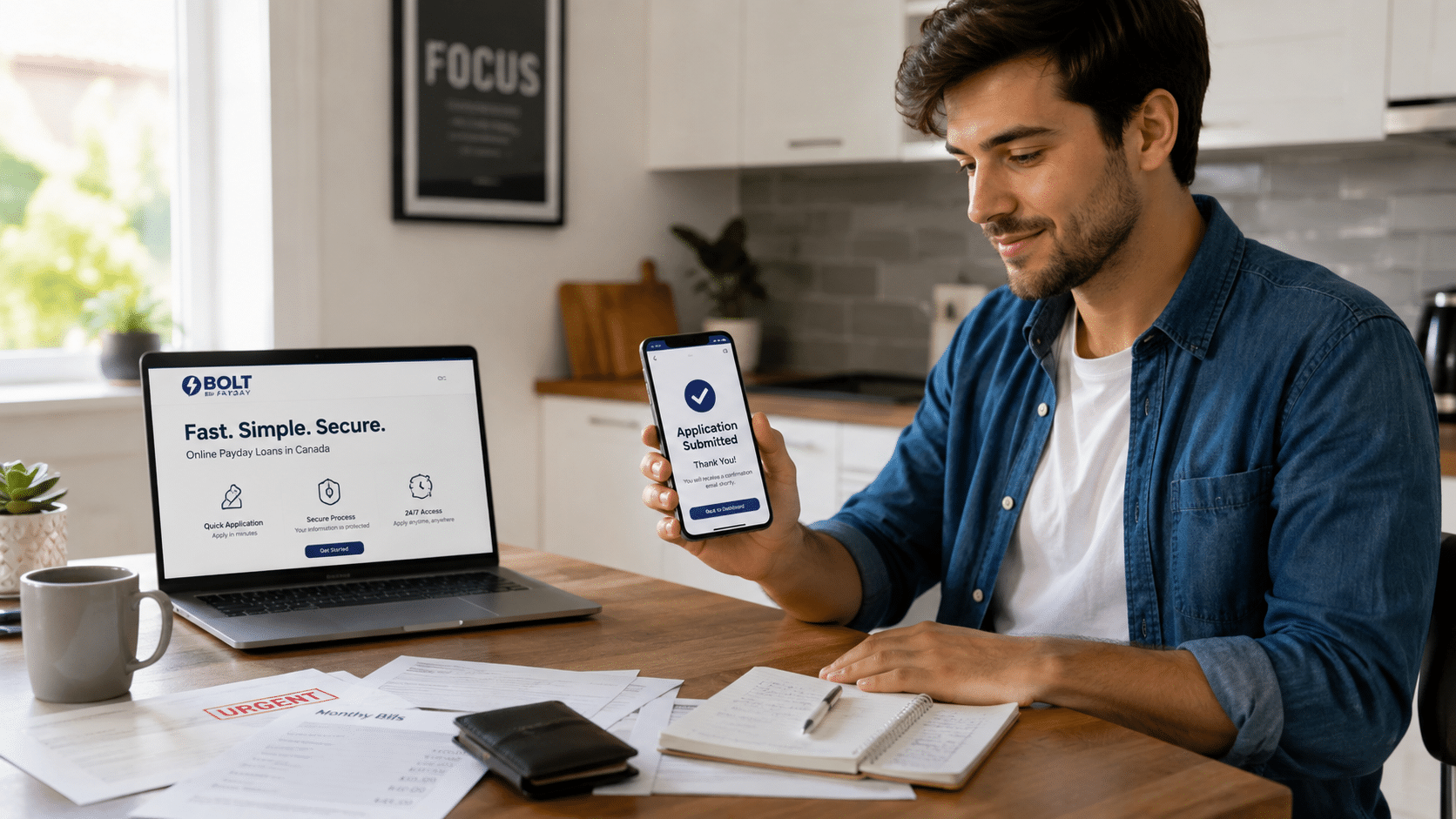
The application takes only a few minutes online. Gather your income details and bank account information first. You can apply for a payday loan online through our short form. We then share your details with one or more lenders.
A lender may present an offer for you to review. You stay free to accept or decline that offer. Read every figure before you sign anything. We connect you with lenders, then step back. The final choice always stays with you.
Frequently Asked Questions
Is Bolt Payday the direct lender for my loan?
No, Bolt Payday is not the direct lender or a bank. We operate as a connection service for Canadian borrowers. We share your registration details with participating lenders. Those lenders set your final rate, fees, and repayment schedule. Only your lender can approve the loan and confirm terms. You stay under no obligation to accept any offer presented to you.
How much does a payday loan really cost in Canada?
The cost of payday loans in most regulated provinces is $14 for every $100 borrowed. A 15-day loan of $300 charges $42 for the loan. On that example you will repay $342 in total. This cost over 12 months is approximately 365 per cent APR. Typically, a late payment will result in a lender NSF fee that is limited to $20. Your bank may impose an additional charge for an NSF, so check the complete monetary impact prior to making any transaction.
Can I get a loan with bad credit or no credit?
Many borrowers with poor or thin credit still apply successfully. Most payday lenders skip a traditional hard credit bureau check. They still verify your income and review your banking activity. So approval depends on real assessment, not on credit alone. Be cautious with any ad promising guaranteed approval for everyone. Steady, verifiable income gives you the strongest chance of an offer.
What does no credit check actually mean?
No credit check usually means no hard credit bureau pull. It does not mean the lender skips all checks. Lenders confirm your income and review recent banking activity. They use that information to judge your repayment ability. So a soft review still shapes the final decision. Treat no refusal and instant approval as possible outcomes only, never as promises.
How much can I borrow, and how long do I have to repay?
The amount of a regulated payday loan in Canada typically is $1,500 or less. Generally, up to 62 days to repay is allowed for borrowers. The amounts we advertise on our site are approximately $2,000. Larger amounts often arrive as personal or installment loans instead. The right amount comes from your need and your repayment ability. Match the loan to your income, not to the highest ceiling offered.
What happens if I cannot repay on time?
A missed payment usually triggers an NSF fee from the lender. Most provinces cap that lender NSF fee at $20. Your bank may charge its own separate NSF fee too. Unpaid balances can grow with added interest and charges. The lender may send the debt to a collection agency. That step can damage your credit report, so contact your lender early.
Can I cancel a payday loan after signing?
Many provinces require a cooling-off period after you sign. This window often lasts around two business days. You can cancel within that window without paying a penalty. You must return the borrowed money to cancel cleanly. Rules vary by province, so confirm your local cooling-off period. Quebec applies much stricter limits, so always read your agreement carefully.
The Bottom Line on Borrowing With Bolt Payday
A payday loan is a tool for a short, urgent gap. It is an expensive way to borrow over time. Use it only when cheaper options cannot arrive fast enough. Borrow the smallest amount that solves your problem. Confirm the total cost and the repayment date first. The Financial Consumer Agency of Canada offers neutral guidance on canada.ca. Bolt Payday connects you with lenders, then steps back. The final choice, and the contract, always stay yours.